

How to feng shui your home when the world feels unstable
- Inbar Lee Hyams
- Mar 22
- 3 min read

Some weeks the newsletter writes itself. This wasn't one of them.
I was sitting on the couch with ingredients that refused to connect: a Torah portion about gratitude. A woman's story about a forest and a war. A feng shui system that asks us to stop rushing.
Then I noticed a card on the floor. The Queen of Spades. That's just how my mind works — I knew immediately she was there for a reason.
Face up. In archetypal symbolism, the Queen of Spades belongs to the suit of hardship and loss. She is not the loss itself — she is what survives it. She knows things that only loss can teach. She was the thread.
This week's Torah portion, Tzav (Leviticus 6:1–8:36), includes the korban todah — the thanksgiving offering. Rabbi Jonathan Sacks notes that Yehudi — Jew — shares its root with todah, thanksgiving. Our name comes from Leah's cry at the birth of Judah: "This time I will thank God." Not in easy times. From within the pain itself.
A woman I don't know wrote a children's story called The Ancient Story of the Forest to help her kids make sense of the war. She wasn't bypassing the grief — she was doing something harder. She trusted that the cycle has its own logic, even as the darkness deepens.
And all of it led to the same place: the earth element in feng shui — and what it can teach us about stopping, waiting, and trusting the cycle.


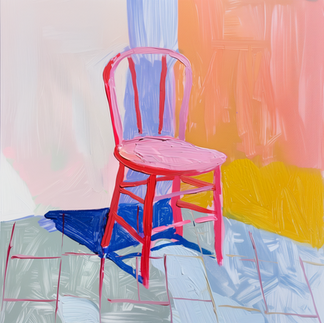


Earth
At the heart of feng shui is a system called Wu Xing — five phases of energy in continuous movement: Wood, Fire, Earth, Metal, Water. Each one becomes the next. Each one has its purpose.
Earth is the phase of late summer. The moment after the growth, before the harvest. Nothing is being planted and nothing is being gathered yet — things are simply ripening. Earth doesn't push. It doesn't rush. It holds what has grown and trusts that the right moment to harvest will come.
That quality — ripening without rushing — is exactly what's being asked of us right now.
That's not gratitude as a feeling you manufacture. That's gratitude as trust that the cycle knows what it's doing — even now.
This week's experiment: find your element
Most homes have a dominant tendency. An element that's taken up more space than the others — in the objects, the colors, the feeling when you walk in. Which of these feels most true?
Stacks of books just acquired, new projects starting before the last ones are done, ideas accumulating faster than they can be acted on? Wood energy. Your home is full of potential and forward momentum — and that's beautiful. Watch for overcrowding: when everything keeps starting without anything completing, energy disperses rather than concentrates. Wood that can't breathe stops growing.
Your home is never quiet — the TV always on, lights bright, something always demanding attention? Fire energy. Your home is alive and engaged. Watch for burnout: when there's no moment of genuine quiet, both the body and the home start burning more than they have. Fire needs to know when to die down.
Heavy and full, hard to move — or warm, a little stuck? Earth energy. Your home is ripening — full, waiting. Not stuck. Ripening. Watch for accumulation: things with nowhere to go, surfaces that never quite clear, objects from a previous chapter still taking up space. When earth doesn't know how to let go, the harvest never comes.
Everything ordered, precise, each thing in its place — but something feels a little frozen, a little too perfect? Metal energy. Your home has been refined — and that's real strength. Watch for rigidity: when order becomes the ruler, there's no room for spontaneity, warmth, or anything unplanned. Metal that doesn't know how to release becomes a tidy prison.
Everything feels fluid, impossible to pin down — things drifting from room to room, not quite belonging anywhere? Water energy. Your home is in flow. Watch for formlessness: when nothing has a permanent home, when everything feels temporary, the home itself never quite lands. Water without banks floods rather than nourishes.
You don't need to change anything. Just notice where you are. That's the practice this week — and it's enough.